
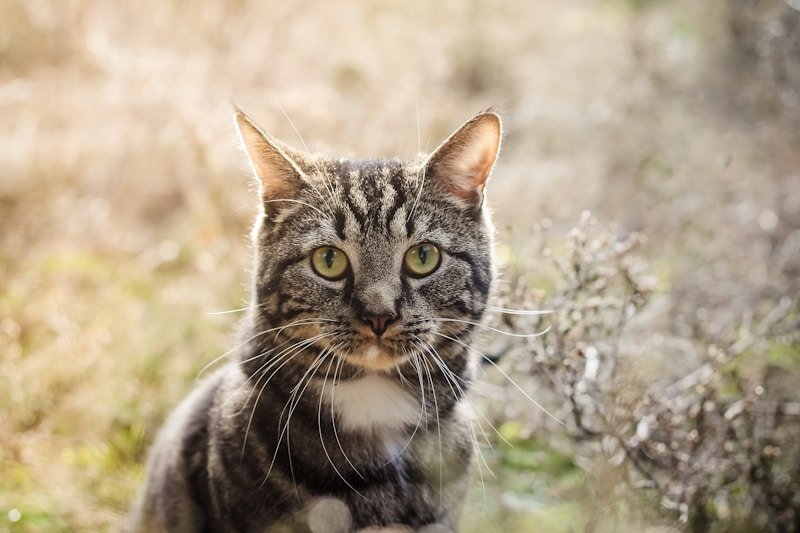
Cats, with their lithe movements, sharp senses, and independent spirits, have captured the hearts of humans for millennia. One of the most fascinating and endearing aspects of their behavior is their innate curiosity, a trait that is often accompanied by the gentle swaying of their whiskers. These whiskers, though delicate, are far more than just a charming physical feature—they play a crucial role in a cat’s interaction with the world. As the wind stirs their whiskers, we are reminded of the deep connection between cats and the environment around them.
In this article, we’ll explore the significance of whiskers in a cat’s life, the way they help navigate their surroundings, and what we can learn from these incredible creatures. Join us as we take a closer look at “Whiskers in the Wind” and uncover the secrets behind one of the most mysterious parts of a cat’s anatomy.
The Sensory Power of Whiskers
Cats’ whiskers, scientifically known as vibrissaes, are not just cute accessories—they are highly sensitive tools used to gather important information about their environment. Unlike the hair on the rest of their bodies, whiskers are deeply embedded in the skin and connected to a network of nerve endings. This makes them incredibly sensitive to touch and allows cats to detect even the slightest changes in their surroundings.
Whiskers are used to gauge the width of openings, sense the presence of objects, and detect movements in the air. When a cat’s whiskers touch something, they send signals to the brain that help the cat understand its position in space. This is particularly useful in low-light conditions or when navigating tight spaces.
Whether they are hunting, exploring, or simply resting, a cat’s whiskers provide essential feedback about the world around them, making them one of the most important sensory tools a cat possesses.
Whiskers as Environmental Indicators
Beyond being a navigational tool, whiskers also serve as indicators of a cat’s mood and state of mind. The position of a cat’s whiskers can give you a subtle clue about how they’re feeling. When a cat is curious, the whiskers often move forward, actively probing their surroundings. On the other hand, when a cat is startled or frightened, their whiskers may move back against their face as a defensive posture.
In the wild, these whisker movements are vital for understanding immediate environmental threats or opportunities. For example, when a cat is on a hunt, its whiskers can detect the movement of prey, helping the cat track down and capture its next meal. Similarly, when a cat senses danger or is in an unfamiliar territory, the whiskers act as a buffer, guiding them to avoid obstacles or potential risks.
Whiskers are truly a window into a cat’s emotional and sensory world, offering a deeper understanding of their behavior.
How Cats Adapt to Their Environment Using Whiskers
The role of whiskers goes beyond simply detecting objects—they are crucial for helping cats adapt to their environment. One fascinating feature of whiskers is their ability to “read” the environment in real-time, adjusting as conditions change. For instance, a cat will often extend its whiskers outward to explore new territory, moving them in different directions to sense the objects around it.
In a low-visibility environment, such as a dark room or a narrow alley, whiskers become even more critical. By brushing the sides of walls or objects, cats can gain a mental map of their surroundings, which is essential for navigating safely. In fact, cats can use their whiskers to estimate the size of gaps or openings, allowing them to slip through tight spaces that might otherwise be impossible to navigate.
Cats’ whiskers are not just useful for physical navigation; they also help them understand and adapt to the ever-changing dynamics of the world around them. Whether it’s adjusting to a new home or learning the intricacies of a new hunting area, whiskers are a key part of a cat’s toolkit for survival and exploration.
The Whisker-Wind Connection: How Nature Influences a Cat’s Behavior
Perhaps one of the most poetic images of a cat is the way its whiskers flutter gently in the wind. When a cat’s whiskers are exposed to the elements, such as the breeze on a warm afternoon, they are sensitive to even the faintest shifts in air movement. This sensitivity is not just a reflex—it’s a sign of how deeply connected cats are to the environment around them.
Whiskers can detect changes in the direction, speed, and intensity of wind. For cats that spend a lot of time outdoors, these small shifts in the air can signal important changes in their environment. For example, a sudden gust of wind might indicate the presence of a larger animal or the arrival of a storm. Whiskers allow cats to sense these subtle cues, helping them make decisions about when to explore or seek shelter.
Additionally, whiskers in the wind can help cats determine the presence of nearby prey. The breeze can carry smells, and whiskers are capable of detecting the slightest odor particles, giving the cat valuable information about the movements of other animals.
Conclusion: The Unseen Power of Whiskers
Whiskers are far more than just a physical trait—they are intricate, finely tuned tools that allow cats to interact with and adapt to their world in ways that humans can only begin to understand. From navigating tight spaces to sensing subtle changes in their environment, whiskers are a testament to the intelligence and precision of these fascinating creatures.
So the next time you see a cat with its whiskers swaying in the wind, take a moment to appreciate the powerful, unseen force guiding them through the world. Whiskers in the wind are not just a gentle, poetic image—they are a reflection of the finely tuned, sensory-driven life that cats lead.